Audiologist vs. Hearing Instrument Specialist
Audiologists offer doctoral-level clinical expertise beyond hearing aid fitting, making them the superior choice for complex hearing loss, tinnitus, and accurate diagnosis.
When you start looking for help with your hearing, you'll probably come across two types of providers: audiologists and hearing instrument specialists. Both can fit you with hearing aids. Beyond that, though, they're quite different — and the distinction matters more than most people realize.
Understanding What an Audiologist Does
An audiologist holds a doctoral-level degree, usually a Doctor of Audiology (Au.D.). That's four years of graduate training on top of a bachelor's degree, covering everything from how the ear and brain process sound to diagnosing complex hearing disorders, balance problems, and tinnitus.
Audiologists evaluate patients of all ages. They run diagnostic hearing tests, identify what's causing your hearing loss, and provide full clinical care — including hearing aid fittings, tinnitus management, and hearing rehabilitation. They're also trained to recognize when something more serious is going on and refer you to the right specialist.
That clinical depth makes a real difference. Hearing loss isn't always simple. Connecting the dots between your medical history, your test results, and your daily listening challenges takes years of training — not just experience with devices.
What a Hearing Instrument Specialist Can and Can't Do
A hearing instrument specialist (HIS) is licensed to test hearing and fit and sell hearing aids. The path to licensure involves a much shorter training program and a state exam — no doctoral degree required. Requirements vary by state.
While some are just interested in selling hearing aids, many hearing instrument specialists are skilled, experienced, and genuinely care about their patients. The difference isn't about dedication — it's about scope. An HIS isn't trained to diagnose hearing disorders, manage tinnitus, or evaluate how your brain processes sound. Their focus is amplification, full stop.
For some patients, that's enough. But if your hearing loss is complicated, if tinnitus is part of the picture, or if you've had issues that weren't fully resolved somewhere else, you'll want someone with clinical training who can actually assess what's happening — not just sell you a device.
Why Your Provider's Training Affects Your Results
Modern hearing aids are remarkably sophisticated. Brands like Phonak, Oticon, Widex, Signia, and Starkey now build devices with AI-driven processing that adapts to your environment in real time. Getting the most out of that technology isn't just about picking the right brand — it depends on someone who understands your specific hearing loss and programs your aids accordingly.
Think of it this way: a well-fitted hearing aid is like a custom prescription. The device is only as effective as the clinical knowledge behind it.
There's also a safety reason to think about credentials. Sudden hearing loss, hearing that's worse in one ear than the other, or unexplained ringing — these can sometimes signal an underlying medical issue. An audiologist is trained to catch those warning signs and get you to the right help fast. A hearing instrument specialist is not.
What to Expect at Doctors Hearing
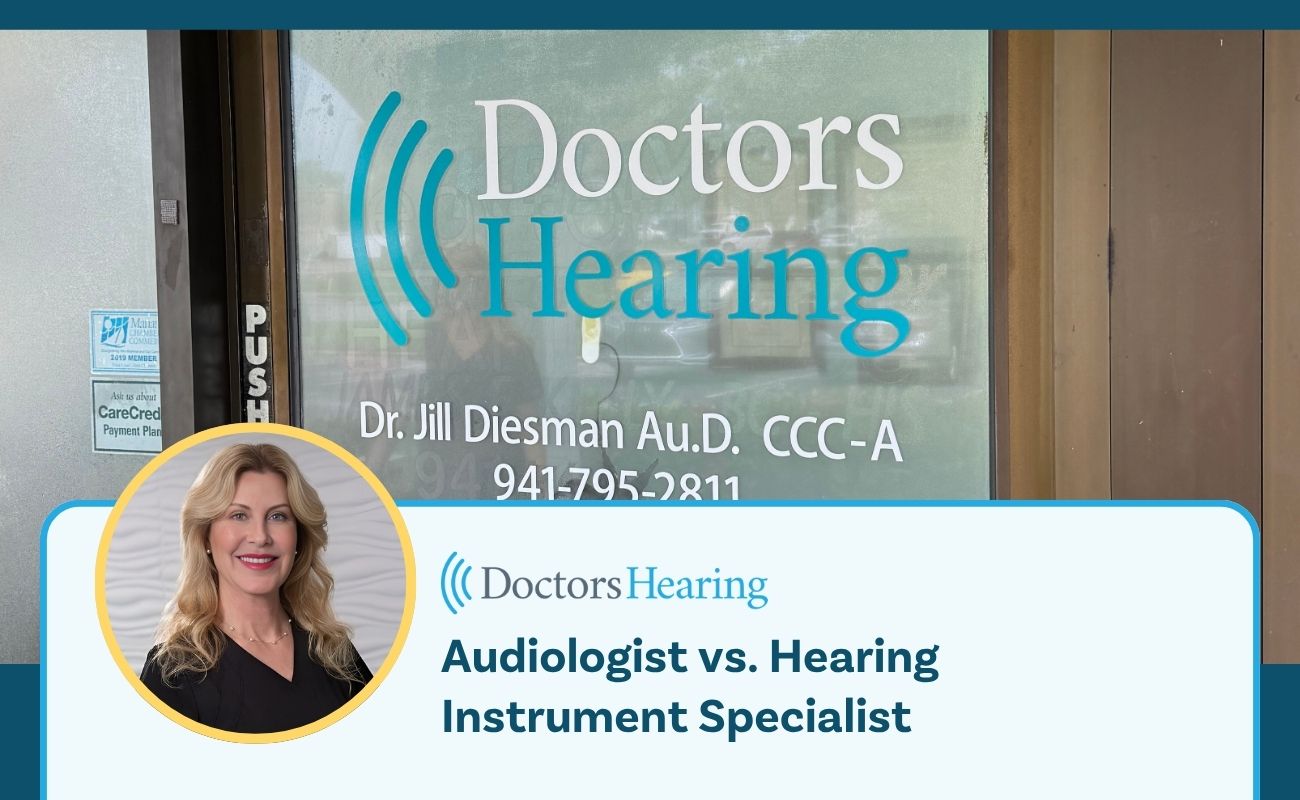
At Doctors Hearing, you'll be seen by Dr. Jill Diesman, a Doctor of Audiology with a master's degree from Washington University in St. Louis and her doctorate from Arizona School of Health Sciences. Dr. Diesman has been caring for patients in the Bradenton area for over twenty years. Her training included extensive clinical work at the Central Institute for the Deaf in St. Louis, one of the most respected audiology programs in the country.
We provide complete hearing evaluations, hearing aid fittings, tinnitus management, and hearing rehabilitation. You won't get a quick product pitch here. You'll get a thorough evaluation from a clinician who wants to understand your specific situation before recommending anything.
Making the Right Call for Your Hearing Health
If your hearing feels fine and you just want a basic checkup, you have options. But if you've noticed changes, struggled to follow conversations, dealt with ringing in your ears, or had a disappointing experience somewhere else, seeing a licensed audiologist is the smarter first step.
Hearing touches nearly everything — conversations with your family, your ability to follow along at work, your confidence in social situations. It deserves more than a rushed fitting and a handshake.
Ready to Get Your Hearing Checked in Bradenton?
Call our office at (941) 795-2811 to schedule a hearing evaluation with Dr. Diesman. We're located at 501 Village Green Pkwy, Suite 16 in Bradenton.
Whether you've been putting it off for years or you just want a second opinion, we're glad to help. Better hearing starts with the right provider, and we're ready when you are.


John Castello